
TanyaOS now treats its desktop as a persistent environment. Chat, Whiteboard, Mind Map, Settings, and Image Gen open as floating glass windows above that space, rather than replacing it with another full-screen surface.
This October 2 update brings the interface closer to that spatial design while continuing the original cognitive architecture. The changes are published in TanyaOS on GitHub.
Windows projected from the dock
The left sidebar has become a compact, bottom-centered glass dock. Its glowing listening ring opens the live cognition status panel when needed, keeping the center of the desktop clear. Settings, System, Logout, and Shutdown remain available through their existing governed controls.
Each floating application measures its own dock button's position. A restrained projection rises from that button, the window materializes above it, and minimizing or closing reverses the motion toward the same origin. The desktop, central core, branding, clock, and dock remain visible beneath these windows.
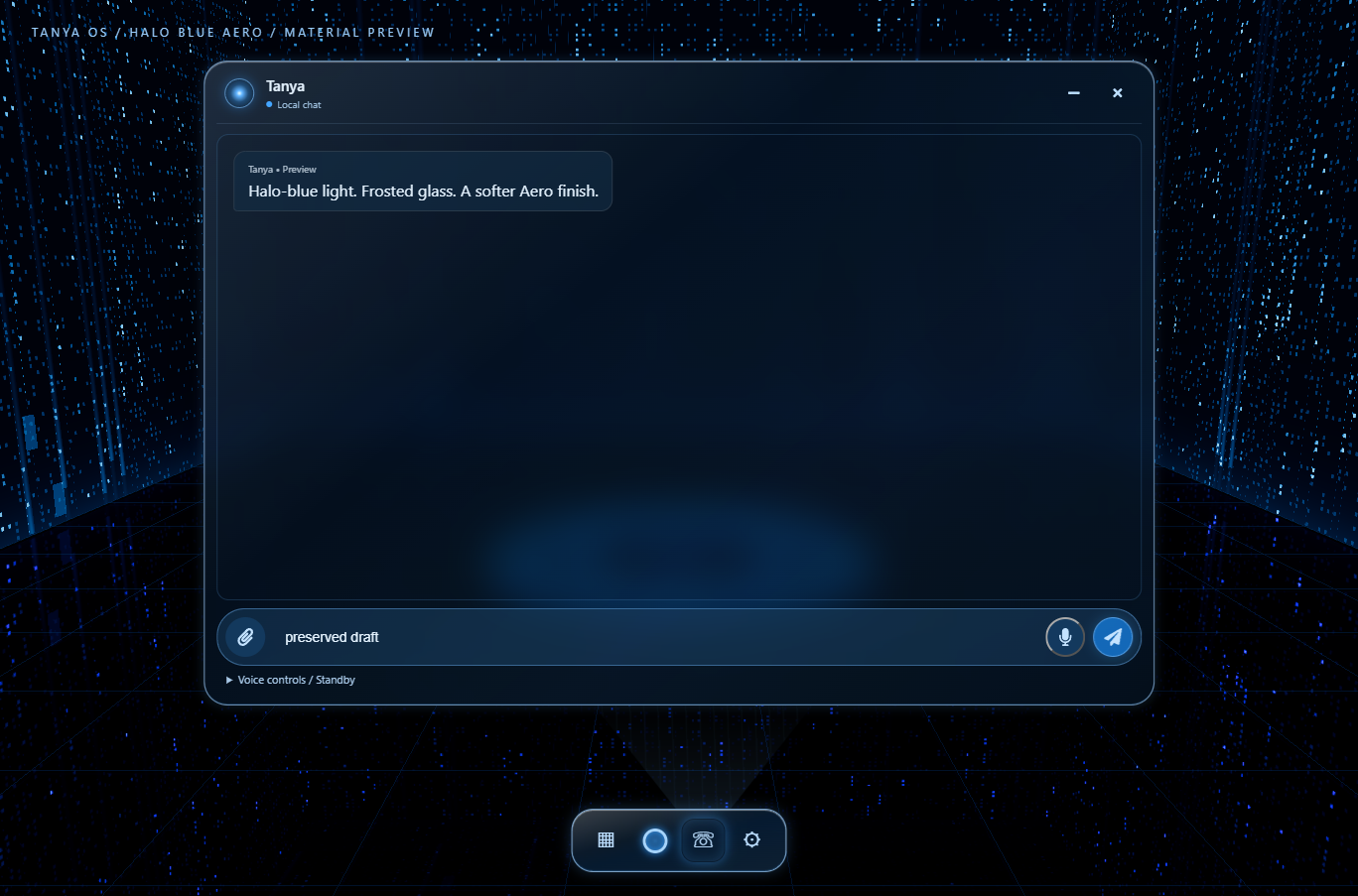
Chat's composer integrates attachments, message input, push-to-talk, and Send. Secondary microphone selection, continuous listening, speech status, and Clear live in an expandable voice section. Desktop dialogue bubbles are hidden while Chat is open, avoiding a second copy of the conversation behind the window.
Whiteboard fits its drawing canvas into the floating window while preserving its drawing buffer. Opened panels keep local state when minimized, including Chat drafts and Whiteboard work. Image Gen has received the window treatment, but its content remains the existing coming-soon placeholder; this update does not add an image-generation engine.
A fixed hologram-blue palette and Aero finish
The decorative palette is now built around #4AA8FF, with deeper blue shadows and icy highlights. It is a Halo Cortana-inspired artistic interpretation, not a sampled match to a particular game frame. The previous time-of-day hue drift has been removed so the interface maintains a consistent blue identity.
Translucent surfaces, saturated backdrop blur, diagonal sheen, illuminated inset edges, and softer shadows provide a Vista-era Aero direction. The chamber's lighting and beveled glass floor rings share the same base blue. Semantic colors still distinguish warnings, errors, and successful states.
The article's image is an isolated component render using the actual theme, Chat, and 3D chamber code. Its simplified dock and sample conversation illustrate materials; it is not a screenshot proving full live desktop acceptance.
More reliable source notifications
The development watcher previously repeated warnings when the local backend could not accept source-change notifications. Failed batches were also dropped.
Notifications now retain pending changes, serialize requests, and retry with bounded backoff. One warning marks an outage and one message confirms delivery has recovered. The diagnostics distinguish notification transport loss from a filesystem watcher failure. Backend hash scanning resumes when the backend is available; it cannot operate while that process is unreachable.
What-if reasoning stays hypothetical
The causal-hypothesis ledger now supports a small, account-owned binary scenario: what effect probability is assumed when a declared cause is present or absent?
The caller supplies the probability assumptions. Missing assumptions stay unknown; the result carries provenance and an explicit hypothetical status. Simulation neither writes an observed memory nor executes an action, establishes causation, or grants permission. Candidate ranking can retain the scenario for inspection without treating unverified probabilities as a scoring advantage.
This is a bounded inspectable what-if mechanism, not validated intervention learning, a general causal model, or evidence of sentience.
Evidence and the next acceptance gates
The latest focused causal/world/value/HTTP test run passed 54 tests. The source-notification change passed all 17 Electron runtime tests, including a local failure/recovery test. UI updates passed component lint, production builds, action registry checks, and desktop preflight with 22 protected core files verified.
Isolated Electron fixtures checked dock-origin alignment, window lifecycle, retained drafts, and retained drawing pixels. These checks are narrower than live end-to-end desktop, microphone, attachment, and multi-resolution acceptance. The broader interactive-surface checker still has 14 existing unrelated gaps.
The supplied cognitive examination documents are plans for future evaluation. Long-duration cognition, independent human comparisons, and packaged update installation remain separate acceptance gates. The project's ambition is unchanged; its present-tense claims stay tied to the evidence available.